




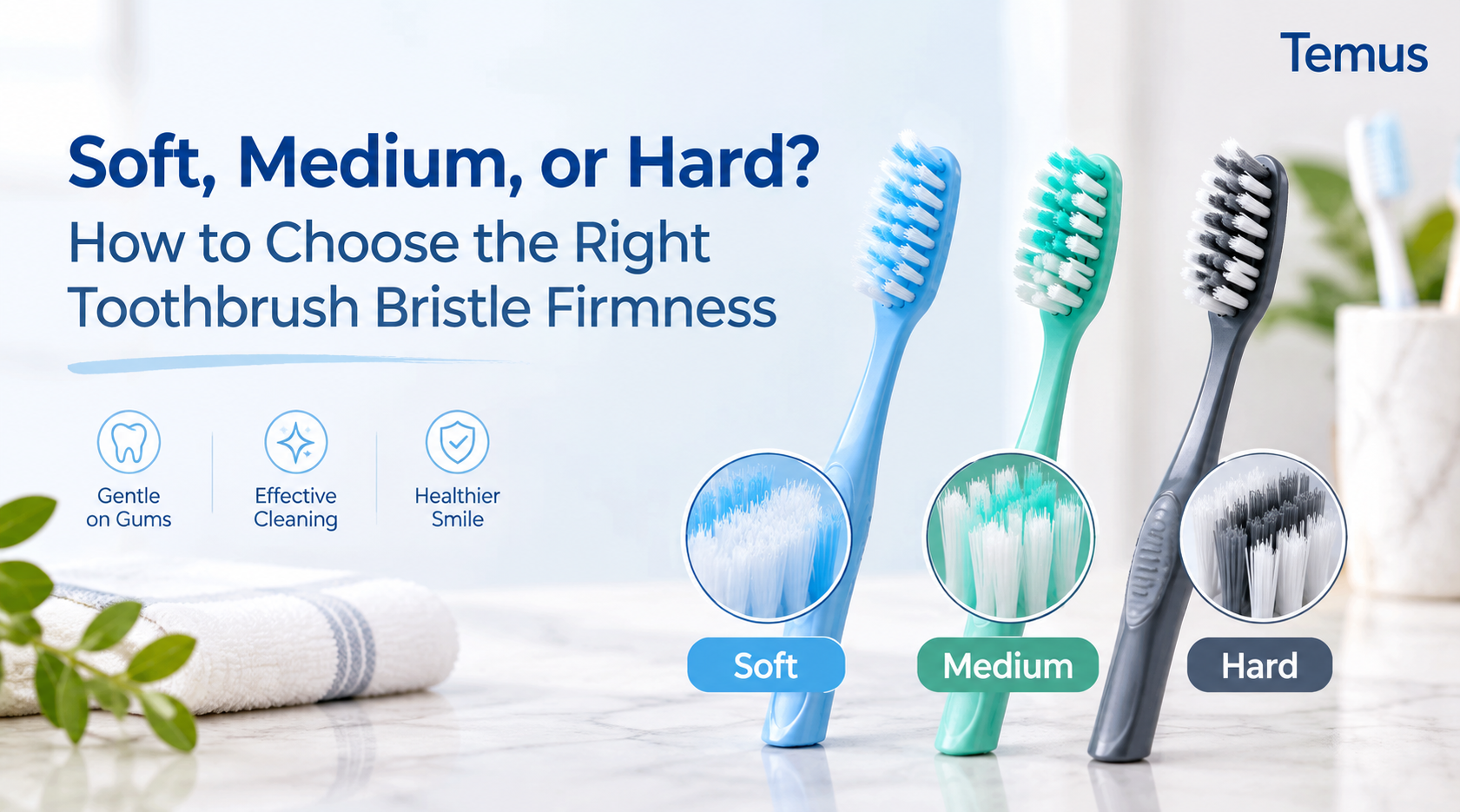
Bristle firmness is one of the smallest specs on a toothbrush spec sheet, but it carries some of the biggest risk for a wholesale buyer. Get it right, and you stock a product that keeps customers healthy and coming back. Get it wrong, and you risk returns, bad reviews, and even complaints tied to gum recession, enamel wear, or tooth sensitivity.
This guide breaks down what actually separates soft, medium, and hard bristles, what the dental research says about each one, and which options belong in your product lineup.
Soft-bristled toothbrushes are the default recommendation from dentists for most adults and children. That is not a marketing claim. The American Dental Association and similar dental bodies worldwide recommend soft bristles as the safe default for daily brushing, because they clean effectively without wearing down enamel or irritating gum tissue.
Soft bristles are flexible enough to bend into the gum line without causing trauma, and they still remove plaque at a rate comparable to firmer bristles when paired with correct brushing technique. For a wholesale buyer, this makes soft bristles the safest volume product in your lineup, and the one least likely to generate a return or complaint.
Discuss soft, medium, or hard bristle options, materials, packaging, private label, OEM, and bulk toothbrush requirements with our team.
Request a QuoteBuyers sourcing for consumers with sensitive gums, existing gum disease, or a history of heavy-handed brushing should look for products labeled “soft” or “extra-soft.” Some manufacturers go a step further with tapered bristle tips, which flex more gently against tissue. That feature works well as a differentiator on a premium line, since it signals a real product upgrade rather than a label change.
Children’s toothbrushes need softer bristles than adult versions. A child’s gums are more delicate, and children have not yet developed consistent brushing control. Pediatric lines should be clearly separated from adult products on packaging, with bristle softness called out as a core selling point rather than a footnote.
Medium bristles sit between soft and hard on both cleaning feel and risk. Some consumers find them more satisfying, since the extra firmness gives a stronger sensation of a thorough clean, and some reviews describe them as feeling more effective at removing plaque.
Medium bristles can work for daily use by consumers who already brush with light pressure and good technique. The risk shows up when that technique slips. Research on brushing force shows that medium and hard bristles are more likely than soft bristles to damage enamel and irritate gums, and the cause is usually not the bristle itself but the pressure behind it. Most people who damage their gums with a firmer brush are pressing too hard, not using a defective product.
If you decide to carry medium-bristle brushes, pair them with clear usage guidance on the packaging, including a warning against heavy pressure. Some manufacturers add a pressure-sensor indicator on the handle, a small design feature that tells the user when they are brushing too hard. For your catalog, medium bristles fill a specific niche: buyers who find soft brushes unsatisfying but are willing to follow instructions for safe use. They need more consumer education than soft bristles do, so factor that into your packaging and marketing spend.
Hard bristles are the smallest and riskiest category in most oral care portfolios, and dental professionals increasingly discourage them for everyday use.
A small number of manufacturers still produce hard-bristle brushes for specific jobs, such as removing heavy surface stains or cleaning dentures. Outside those narrow uses, hard bristles have mostly disappeared from mainstream product lines, because the health case for them is weak and the liability case against them is strong.
Clinical research links hard-bristle, high-pressure brushing to faster enamel wear and gum recession, and to wedge-shaped defects at the base of the tooth in long-term users. For a wholesaler weighing whether to stock hard bristles, the decision usually comes down to one question: does the niche demand for this product outweigh the return and complaint risk it carries? For most catalogs, the answer is to keep hard bristles as a small, clearly labeled specialty item rather than a mainstream SKU.
Firmness is only half the spec. The material a bristle is made from affects how it performs, how long it lasts, and how premium it feels to the end buyer.
Most toothbrush bristles today are made from nylon, valued for its durability, flexibility, and resistance to moisture. Nylon bends under pressure during brushing and springs back to shape afterward, which is part of why it replaced natural bristle brushes decades ago. Within nylon, different grades perform differently. Nylon 6/12, for example, absorbs less water than nylon 6/6 and holds its stiffness better when wet, which gives a more consistent brushing feel over the life of the product.
Tynex is a well-known premium nylon filament brand used across high-quality toothbrushes. It was originally a DuPont product and is now manufactured and sold by Celanese, following Celanese’s 2022 acquisition of DuPont’s filament business. Tynex filaments are valued for consistent diameter control, wear performance, and manufacturing yield, and some variants add visual features like diamond-cut shapes or color effects. Specifying Tynex on a private-label order is a straightforward way to signal quality to retail partners who recognize the brand name.
Buyers serving price-sensitive markets can source generic nylon or copy-nylon filaments at a lower cost than branded options like Tynex. The trade-off is real: lower-grade filaments tend to fray sooner, lose their shape faster, and offer a less consistent safety profile from batch to batch. The savings on unit cost can be offset by a higher return rate and, over time, by damage to your brand’s reputation with retail partners.
Understanding how suppliers test bristles helps you evaluate them and verify their claims before you place a purchase order.
Reliable manufacturers measure bristle diameter against a fixed tolerance, since even small variations affect both comfort and cleaning performance. They also run stiffness tests using standardized methods, which is how a supplier can back up a “soft” or “medium” label with data instead of a guess.
Bristle tips must be rounded and smooth, a finishing step known as end rounding. A poorly finished bristle has a sharp tip that can cause micro-abrasions on gum tissue with regular use. Ask suppliers directly whether end rounding is inspected on every batch or only on samples.
Manufacturers pull random samples from each production batch to check for defects before shipment. This is what lets you promise a retail partner that every toothbrush in a shipment meets the same standard, not just the sample you approved.
Bristles should pass safety testing for cytotoxicity, heavy metals, and phthalates before they reach a retail shelf, in line with global safety regulations. A reputable supplier will hold certifications such as ISO 13485 or will document FDA compliance for the US market, and should be willing to share that documentation without being asked twice.
Even a well-made toothbrush wears out. Educating your retail customers on replacement timing builds trust and drives repeat purchases of your product, not a competitor’s.
Once bristles fray, bend, or splay outward, the brush loses its ability to reach into tight spaces between teeth and along the gumline. Worn bristles clean less effectively and can irritate gum tissue rather than protect it.
Dentists generally recommend replacing a toothbrush every three months. Heavy brushers or people who apply more pressure than recommended may need to replace theirs sooner, since their bristles wear out faster.
Replacing a toothbrush after a cold, flu, or other illness is also good practice, since bacteria and viruses can survive on bristles for a period after use. Sharing this guidance with retail partners, so it reaches the end consumer, positions your brand as informed rather than purely transactional.
A strong supplier relationship protects both your business and your customers, and the right questions early on prevent costly problems later.
Ask for documentation of the supplier’s testing protocols, including what standards they test against and how they maintain batch-to-batch consistency. A supplier confident in their process will share this without hesitation.
Ask what customization options are available for bristle firmness, handle design, and packaging, and whether the supplier offers multiple material grades to match different price points in your catalog.
Ask where bristle filaments come from and whether the supplier uses branded material, such as Tynex, or a generic alternative. Knowing the source of the filament gives you a clearer basis for pricing and quality decisions than the finished brush alone.
| Firmness | Best For | Cleaning Power | Key Consideration |
| Soft | Sensitive gums, children, everyday use | High, with correct technique | The clinically recommended default for most users |
| Medium | General daily use by experienced brushers | Moderate to high | Requires proper technique and consumer education to avoid damage |
| Hard | Stain removal, denture cleaning | Lower for routine brushing | Higher risk of enamel and gum damage; best kept as a specialty item |
Your bristle firmness decisions affect real customers, not just SKUs on a purchase order. Soft bristles remain the safest, highest-volume choice for most buyers. Medium bristles serve a real but narrower niche, and they need supporting education to be sold responsibly. Hard bristles carry the highest risk and belong in a small, clearly labeled segment of your catalog rather than your core lineup.
Stocking the right mix, backed by the testing and sourcing questions above, protects your margins and your customers at the same time.
More Blog Like this
How to Choose the Right Toothbrush Manufacturer for Your Product Line
Choosing the right toothbrush manufacturer is important for buyers planning bulk orders. Importers, wholesalers, distributors, retailers, and private label brands need more than a low product price. They should compare toothbrush quality, bristle materials, MOQ, customization options, production capacity, packaging, quality control, and lead times before placing an order. At TEMUS, A proper comparison helps buyers find a manufacturer that can meet their product requirements and support regular supply. What to Check When Comparing Toothbrush Manufacturers When comparing toothbrush manufacturers, buyers should first understand what each manufacturer can provide. Product specifications, manufacturing capacity, quality control, and experience with bulk orders can affect the final quality and cost of a product line. Product Quality and Toothbrush Specifications Start by checking the basic specifications of the toothbrushes. Look at the handle material, handle design, brush head size, bristle material, bristle firmness, bristle density, and overall finishing. These details can affect how the toothbrush feels and performs during use. Buyers should also ask whether the manufacturer can produce different specifications for different markets. For example, a retailer may need soft bristles for a sensitive care product, while another brand may require medium bristles for a general oral care range. Clear product specifications make it easier to compare samples and quotations from different manufacturers. Manufacturing Capacity and Bulk Order Experience Production capacity is another important factor for B2B buyers. A manufacturer may offer a competitive price but may not have enough production capacity for large or repeat orders. Ask about production capacity, average lead time, and experience with bulk orders before making a decision. If you plan to reorder the same toothbrush regularly, choose a manufacturer that can maintain consistent production and product specifications. Stable production can help businesses manage inventory and avoid delays when demand increases. Quality Control and Production Standards Ask manufacturers about their quality control process before placing a bulk order. A reliable process may include checking raw materials, inspecting products during production, and checking finished toothbrushes before shipment. Buyers should also ask about available product testing and certifications when these are required for their target market. This is especially important when importing toothbrushes into countries with specific product or packaging requirements. Read this blog Soft, Medium, or Hard? How to Choose the Right Toothbrush Bristle Firmness Compare Toothbrush Manufacturers by Pricing and Customization Price matters for bulk buyers, but it shouldn't be the only comparison point. A low unit price may come with a higher MOQ, limited customization, basic packaging, or different product specifications. Buyers should compare the complete quotation and understand what is included before comparing prices. MOQ and Bulk Toothbrush Pricing Minimum order quantity can vary between toothbrush manufacturers. Some manufacturers may accept smaller trial orders, while others may require a larger production quantity for customized products. When requesting a quotation, provide the expected order quantity, toothbrush specifications, bristle requirements, packaging needs, and destination market. This allows manufacturers to provide a more useful quotation. Buyers should also ask whether the quoted price includes packaging, customization, and other production costs. OEM and Private Label Options Brands that want to sell toothbrushes under their own name should check the manufacturer's OEM and private label capabilities. Custom production may include logo printing, custom colors, handle designs, bristle options, packaging, and retail boxes. Before selecting a manufacturer, ask which parts of the toothbrush can be customized and whether there are additional costs for custom molds, printing, packaging, or sample development. This helps buyers calculate the actual cost of launching a customized product. Packaging and Order Requirements Packaging is an important part of a bulk toothbrush order, especially for retailers and private label brands. Ask manufacturers about individual packaging, multi-piece packs, retail boxes, carton quantities, labels, barcodes, and other packaging options. Good packaging planning can also help with transportation and warehouse handling. Buyers should confirm packaging dimensions and carton information before finalizing a large order. How to Evaluate a Toothbrush Manufacturer Before Placing an Order After comparing product specifications and prices, buyers should evaluate the manufacturer itself. This includes checking samples, communication, production support, lead times, and shipping arrangements. Request Samples Before a Bulk Order Samples allow buyers to check the actual product before committing to a large quantity. Inspect the toothbrush handle, bristles, brush head, finishing, packaging, and overall product quality. If you are comparing several toothbrush manufacturers, request similar samples from each supplier. Using the same specifications makes it easier to compare product quality and identify differences before placing a bulk order. Check Communication and Production Support Clear communication is important when working with an international manufacturer. The supplier should be able to provide clear information about specifications, MOQ, pricing, samples, production schedules, packaging, and shipping. For customized orders, communication becomes even more important. Product drawings, logo files, packaging designs, and specifications should be confirmed before production starts to reduce the risk of mistakes. Review Lead Time and Shipping Support Ask about sample lead time, production lead time, and estimated shipping time. Buyers should understand the complete order timeline instead of looking only at the manufacturing period. It is also useful to ask whether the manufacturer has experience exporting to your target market. Understanding shipping methods, carton details, and required export documents can make the ordering process easier. Read this guide How to Choose the Right Toothbrush Manufacturer for Your Product Line Questions to Ask Toothbrush Manufacturers Before Ordering Before placing a bulk order, prepare a list of questions for each manufacturer. This helps buyers collect comparable information and identify differences between suppliers: What is your MOQ for bulk toothbrush orders? Which bristle materials and firmness levels do you offer? Can you produce custom toothbrush designs? Do you provide OEM and private label services? Can you provide samples before bulk production? What quality control process do you follow? What is your production lead time? What packaging options are available? Can you support repeat and large volume orders? What export and shipping support do you provide? How to Choose the Right Toothbrush Manufacturer for Your Bulk Order Comparing toothbrush manufacturers requires more than checking the lowest quotation. B2B buyers should review product quality, bristle specifications, MOQ, pricing, customization, production capacity, quality control, packaging, lead time, and communication. For a first order, requesting samples and confirming all specifications before production can reduce purchasing risks. Buyers should also keep a clear record of quotations and product requirements so different manufacturers can be compared using the same criteria. A manufacturer that can consistently meet your product specifications and bulk supply requirements can become a useful long-term supplier for your toothbrush business. Whether you are a wholesaler, distributor, retailer, or private label brand, a detailed supplier comparison can help you plan your order with greater clarity. FAQs About Comparing Toothbrush Manufacturers What should I compare when choosing a toothbrush manufacturer? Compare product quality, bristle materials, MOQ, pricing, customization, production capacity, quality control, packaging, lead time, samples, and export support. Looking at these factors together gives B2B buyers a clearer view of the complete supplier offer. Can toothbrush manufacturers provide private label products? Many manufacturers offer private label production, but available services can vary. Buyers should confirm options for custom handles, colors, logos, bristles, packaging, and other product specifications before placing an order. Should I request toothbrush samples before a bulk order? Yes. Samples allow buyers to check the actual toothbrush quality and compare products from different manufacturers. They can also confirm bristle firmness, handle design, finishing, packaging, and other specifications before bulk production. How can I get a quotation from a toothbrush manufacturer? Provide the manufacturer with your required quantity, toothbrush design, bristle material and firmness, packaging requirements, customization needs, and destination market. Detailed information helps the manufacturer prepare a more accurate quotation.
READ FULLBristle firmness is one of the smallest specs on a toothbrush spec sheet, but it carries some of the biggest risk for a wholesale buyer. Get it right, and you stock a product that keeps customers healthy and coming back. Get it wrong, and you risk returns, bad reviews, and even complaints tied to gum recession, enamel wear, or tooth sensitivity. This guide breaks down what actually separates soft, medium, and hard bristles, what the dental research says about each one, and which options belong in your product lineup. Soft Bristles: The Standard Choice for Most Users Soft-bristled toothbrushes are the default recommendation from dentists for most adults and children. That is not a marketing claim. The American Dental Association and similar dental bodies worldwide recommend soft bristles as the safe default for daily brushing, because they clean effectively without wearing down enamel or irritating gum tissue. Soft bristles are flexible enough to bend into the gum line without causing trauma, and they still remove plaque at a rate comparable to firmer bristles when paired with correct brushing technique. For a wholesale buyer, this makes soft bristles the safest volume product in your lineup, and the one least likely to generate a return or complaint. Source the Right Toothbrush Bristle Firmness Discuss soft, medium, or hard bristle options, materials, packaging, private label, OEM, and bulk toothbrush requirements with our team. Request a Quote Soft Bristles for Sensitive Gums Buyers sourcing for consumers with sensitive gums, existing gum disease, or a history of heavy-handed brushing should look for products labeled “soft” or “extra-soft.” Some manufacturers go a step further with tapered bristle tips, which flex more gently against tissue. That feature works well as a differentiator on a premium line, since it signals a real product upgrade rather than a label change. Soft Bristles for Children Children’s toothbrushes need softer bristles than adult versions. A child’s gums are more delicate, and children have not yet developed consistent brushing control. Pediatric lines should be clearly separated from adult products on packaging, with bristle softness called out as a core selling point rather than a footnote. Medium Bristles: A Balanced but Niche Option Medium bristles sit between soft and hard on both cleaning feel and risk. Some consumers find them more satisfying, since the extra firmness gives a stronger sensation of a thorough clean, and some reviews describe them as feeling more effective at removing plaque. When Medium Bristles Make Sense Medium bristles can work for daily use by consumers who already brush with light pressure and good technique. The risk shows up when that technique slips. Research on brushing force shows that medium and hard bristles are more likely than soft bristles to damage enamel and irritate gums, and the cause is usually not the bristle itself but the pressure behind it. Most people who damage their gums with a firmer brush are pressing too hard, not using a defective product. What to Consider Before Stocking Medium Bristles If you decide to carry medium-bristle brushes, pair them with clear usage guidance on the packaging, including a warning against heavy pressure. Some manufacturers add a pressure-sensor indicator on the handle, a small design feature that tells the user when they are brushing too hard. For your catalog, medium bristles fill a specific niche: buyers who find soft brushes unsatisfying but are willing to follow instructions for safe use. They need more consumer education than soft bristles do, so factor that into your packaging and marketing spend. Hard Bristles: Limited Use, Higher Risk Hard bristles are the smallest and riskiest category in most oral care portfolios, and dental professionals increasingly discourage them for everyday use. Why Hard Bristles Are Rare Today A small number of manufacturers still produce hard-bristle brushes for specific jobs, such as removing heavy surface stains or cleaning dentures. Outside those narrow uses, hard bristles have mostly disappeared from mainstream product lines, because the health case for them is weak and the liability case against them is strong. Enamel and Gum Wear Risk Clinical research links hard-bristle, high-pressure brushing to faster enamel wear and gum recession, and to wedge-shaped defects at the base of the tooth in long-term users. For a wholesaler weighing whether to stock hard bristles, the decision usually comes down to one question: does the niche demand for this product outweigh the return and complaint risk it carries? For most catalogs, the answer is to keep hard bristles as a small, clearly labeled specialty item rather than a mainstream SKU. Bristle Material Matters Too Firmness is only half the spec. The material a bristle is made from affects how it performs, how long it lasts, and how premium it feels to the end buyer. Nylon Bristles Most toothbrush bristles today are made from nylon, valued for its durability, flexibility, and resistance to moisture. Nylon bends under pressure during brushing and springs back to shape afterward, which is part of why it replaced natural bristle brushes decades ago. Within nylon, different grades perform differently. Nylon 6/12, for example, absorbs less water than nylon 6/6 and holds its stiffness better when wet, which gives a more consistent brushing feel over the life of the product. Tynex Filaments Tynex is a well-known premium nylon filament brand used across high-quality toothbrushes. It was originally a DuPont product and is now manufactured and sold by Celanese, following Celanese’s 2022 acquisition of DuPont’s filament business. Tynex filaments are valued for consistent diameter control, wear performance, and manufacturing yield, and some variants add visual features like diamond-cut shapes or color effects. Specifying Tynex on a private-label order is a straightforward way to signal quality to retail partners who recognize the brand name. Lower-Cost Alternatives Buyers serving price-sensitive markets can source generic nylon or copy-nylon filaments at a lower cost than branded options like Tynex. The trade-off is real: lower-grade filaments tend to fray sooner, lose their shape faster, and offer a less consistent safety profile from batch to batch. The savings on unit cost can be offset by a higher return rate and, over time, by damage to your brand’s reputation with retail partners. How Manufacturers Test and Grade Bristle Quality Understanding how suppliers test bristles helps you evaluate them and verify their claims before you place a purchase order. Diameter and Firmness Testing Reliable manufacturers measure bristle diameter against a fixed tolerance, since even small variations affect both comfort and cleaning performance. They also run stiffness tests using standardized methods, which is how a supplier can back up a “soft” or “medium” label with data instead of a guess. End Rounding Bristle tips must be rounded and smooth, a finishing step known as end rounding. A poorly finished bristle has a sharp tip that can cause micro-abrasions on gum tissue with regular use. Ask suppliers directly whether end rounding is inspected on every batch or only on samples. Batch Consistency Manufacturers pull random samples from each production batch to check for defects before shipment. This is what lets you promise a retail partner that every toothbrush in a shipment meets the same standard, not just the sample you approved. Safety Testing Before Shipment Bristles should pass safety testing for cytotoxicity, heavy metals, and phthalates before they reach a retail shelf, in line with global safety regulations. A reputable supplier will hold certifications such as ISO 13485 or will document FDA compliance for the US market, and should be willing to share that documentation without being asked twice. When to Replace a Toothbrush Even a well-made toothbrush wears out. Educating your retail customers on replacement timing builds trust and drives repeat purchases of your product, not a competitor’s. Frayed or Bent Bristles Once bristles fray, bend, or splay outward, the brush loses its ability to reach into tight spaces between teeth and along the gumline. Worn bristles clean less effectively and can irritate gum tissue rather than protect it. The Three-Month Rule Dentists generally recommend replacing a toothbrush every three months. Heavy brushers or people who apply more pressure than recommended may need to replace theirs sooner, since their bristles wear out faster. After Illness Replacing a toothbrush after a cold, flu, or other illness is also good practice, since bacteria and viruses can survive on bristles for a period after use. Sharing this guidance with retail partners, so it reaches the end consumer, positions your brand as informed rather than purely transactional. Questions to Ask Your Toothbrush Supplier A strong supplier relationship protects both your business and your customers, and the right questions early on prevent costly problems later. Quality Control Documentation Ask for documentation of the supplier’s testing protocols, including what standards they test against and how they maintain batch-to-batch consistency. A supplier confident in their process will share this without hesitation. Private Label Customization Ask what customization options are available for bristle firmness, handle design, and packaging, and whether the supplier offers multiple material grades to match different price points in your catalog. Material Sourcing and Traceability Ask where bristle filaments come from and whether the supplier uses branded material, such as Tynex, or a generic alternative. Knowing the source of the filament gives you a clearer basis for pricing and quality decisions than the finished brush alone. Bristle Firmness at a Glance Firmness Best For Cleaning Power Key Consideration Soft Sensitive gums, children, everyday use High, with correct technique The clinically recommended default for most users Medium General daily use by experienced brushers Moderate to high Requires proper technique and consumer education to avoid damage Hard Stain removal, denture cleaning Lower for routine brushing Higher risk of enamel and gum damage; best kept as a specialty item Conclusion Your bristle firmness decisions affect real customers, not just SKUs on a purchase order. Soft bristles remain the safest, highest-volume choice for most buyers. Medium bristles serve a real but narrower niche, and they need supporting education to be sold responsibly. Hard bristles carry the highest risk and belong in a small, clearly labeled segment of your catalog rather than your core lineup. Stocking the right mix, backed by the testing and sourcing questions above, protects your margins and your customers at the same time. More Blog Like this How to Choose the Right Toothbrush Manufacturer for Your Product Line
READ FULLPicking a toothbrush manufacturer sounds simple until you are the one responsible for an assortment that customers will actually buy again. For retailers, distributors, and private label brands, a poor sourcing decision does not just mean one disappointed customer. It means slow-moving stock, higher return rates, and a product range that never quite fits the people you are trying to sell to. That is why choosing a toothbrush manufacturer should start with your end user, not with a supplier's catalog. Before you compare quotations or bristle counts, you need a clear picture of who will use the product, how they will use it, and which specific problem it needs to solve. Here is a practical way to work through that decision. Start With the End User: Why Toothbrush Sourcing Begins with Customer Needs The most common sourcing mistake is searching for one "best" toothbrush to fit every customer. In reality, different users have different mouths, habits, and comfort needs, and a single generic design rarely serves all of them well. Adult Users Want a Balance Between Comfort and Cleaning Performance Adult buyers usually want a balance of cleaning performance, comfort, and appearance, but preferences still vary inside that group. Some shoppers want a compact head, often in the 22–26mm range, so they can reach back molars more easily. Others prioritize a wider handle or softer nylon bristles, such as DuPont Tynex filaments, for a gentler brushing feel. If your current range only offers one head size and one bristle grade, you are likely losing sales to competitors who split their assortment further. Children Need Smaller Heads and Sturdier Construction Children need a different starting point entirely. A kids' toothbrush should have a smaller head and a shorter, thicker handle that is easier for a small hand to grip, along with soft, rounded bristle tips to protect developing gums. Bright colors and character designs help, but they only matter if the brush also holds up to daily use. A toothbrush that looks appealing on the shelf but snaps or splays within a few weeks will generate returns and damage repeat purchase rates, regardless of how well it photographed in your product listing. Sensitive Gum Users Prioritize Comfort Over Aggressive Cleaning Buyers with sensitive gums are usually looking for comfort first and aggressive cleaning second. For this group, look past a simple "soft" label on a spec sheet. Check the actual bristle configuration, the taper of each filament tip, and how the handle is shaped to support light, controlled pressure. Sourcing the complete package, not just one soft-bristle feature, is what will actually differentiate your listing from a dozen similar-looking alternatives. Orthodontic Wearers Need Specialized Bristle Patterns Customers wearing braces face a more specific challenge, since brackets and wires create spots where food and plaque collect and standard bristle patterns cannot reach well. An orthodontic toothbrush typically uses a V-shaped or multi-level trim to clean around hardware more effectively. Treating this as a defined category, rather than a minor variation on your standard adult brush, gives you a genuine reason for a customer to choose your range over a competitor's. Travelers Prioritize Portability and Protective Packaging Travelers care most about portability. A travel toothbrush usually needs a folding or telescoping handle, a protective cap, and packaging that keeps the bristles clean between uses. This is also a natural upsell opportunity, since travel kits often bundle in cases, toothpaste tubes, or floss picks at a higher margin than a standalone bathroom brush. The table below summarizes how these segments typically differ, which is a useful quick reference when you are briefing a manufacturer or building a spec sheet. User Segment Recommended Head Size Bristle Type Key Feature to Prioritize Adults 22–26mm Soft to medium nylon (e.g. Tynex) Balance of comfort and cleaning power Children 16–20mm Extra-soft, rounded tips Small grip, gentle on developing gums Sensitive gums 20–24mm Ultra-soft, tapered filaments Controlled, low-pressure brushing Orthodontic wearers 22–24mm V-shaped or multi-level trim Cleans effectively around brackets and wires Travelers Compact or folding head Standard soft to medium Portability and bristle protection Why Handle Design and Grip Affect Comfort More Than Visual Appeal It is easy to treat handle design as a cosmetic decision, but in practice it shapes comfort, control, and how a customer judges the overall quality of the product. An ergonomic handle uses curves and grip zones to sit more naturally in the hand, which matters most for users who brush for longer periods or who have some difficulty maintaining a steady grip. This kind of design detail can support a stronger price position than competing on cost alone, since customers who feel the difference are often willing to pay for it. Grip texture matters just as much. Textured rubber sections or molded grip areas help prevent slipping when hands are wet, which is exactly the condition every toothbrush is used in. When you review samples from a manufacturer, do not judge grip quality from a photo or a spec sheet. Hold the sample yourself, and test it with a wet hand before you approve it, because a feature that reads well on paper does not always perform well in the bathroom. Handle length, thickness, and weight distribution round out the picture. A handle that is too thin can feel flimsy, while one that is too bulky can reduce control, and poor weight balance makes even a well-designed brush feel awkward in use. If you serve more than one customer segment, plan on sourcing more than one handle format rather than forcing every buyer into the same shape. How to Decide How Broad Your Toothbrush Product Mix Should Be A standard manual toothbrush remains a practical, easy-to-understand product for broad retail and distribution, and it works well as an entry-level SKU or a high-volume line item. Even so, a standard brush does not need to look completely ordinary. Small differences in handle shape, bristle color, and packaging can move a basic brush into a higher price tier without adding real production complexity. Beyond the standard brush, specialty formats let you capture demand you would otherwise miss. Orthodontic brushes, discussed above, are one clear example. Interdental brushes and other targeted cleaning tools are another, and they are particularly relevant if you sell into dental-adjacent retail channels or are building a fuller oral care portfolio rather than a single hero product. The goal is not to pad your catalog with SKUs for their own sake; every product you add should solve a problem your existing range does not already cover. If your line includes handles with replaceable heads, compatibility becomes a real operational detail rather than an afterthought. Customers need a clear, documented way to know which replacement heads fit which handle. Vague or missing compatibility information is one of the more preventable causes of wrong orders and return requests in this category. A workable toothbrush product mix usually includes: ● A core adult toothbrush to cover the broadest portion of your customer base without adding unnecessary SKU complexity ● A children's option for households shopping for age-appropriate oral care products ● A sensitive-use option for customers who prioritize gentler brushing ● A specialty or orthodontic option to capture demand from users with specific cleaning requirements ● A travel option for customers who brush away from home which combination makes sense depends on your market, your sales channel, and your available shelf or warehouse space. Adding more SKUs is not automatically an improvement if some of them will not sell. Why Toothbrush Packaging Still Has to Do Real Commercial Work A well-designed toothbrush can still underperform commercially if the packaging fails to communicate its value or protect it in transit. Packaging has to do two jobs at once: protect the product through shipping, warehousing, and shelf handling, and communicate the right information clearly to the customer standing in front of it. Attractive packaging that arrives crushed or torn is not a functional packaging solution, no matter how good it looked in the design file. On a crowded shelf or product page, clear positioning, readable copy, and consistent branding help a range stand out and look intentional rather than assembled from mismatched parts. If you are sourcing multiple SKUs at once, review the packaging as one connected visual system rather than approving each box in isolation. Private label sourcing gives you more control here, letting you adjust branding, structure, artwork, and color depending on what your manufacturer can support. That flexibility comes at a cost, though: custom packaging usually adds both expense and lead time, so confirm exactly what your manufacturer can produce at your target order volume before you commit to a design. How to Evaluate and Choose the Right Toothbrush Manufacturer Once you know what you want to sell, the decision shifts from product selection to sourcing strategy, and the lowest quotation is rarely enough information to choose a manufacturer on its own. Product Quality and Certifications Should Come Before Price Look closely at product consistency first. Inaccurate head dimensions, inconsistent bristle quality, or variable materials from batch to batch will generate quality complaints that reflect on your brand, not the factory's. Ask how a manufacturer performs quality control during and after production, and request documentation, especially if you are sourcing for a higher-end position or a fully private label product. Many established toothbrush factories manufacture to ISO 20126 bristle stiffness standards or hold ADA Seal of Acceptance compliance for the US market; asking for this documentation upfront is a fast way to separate serious suppliers from the rest. Capacity, Communication, and Order Terms Matter as Much as Samples Production capacity is worth checking separately from quality. A supplier who handles a small trial order well does not always scale cleanly to your full volume, so ask directly about their capacity at the order size you actually plan to place. Communication speed and clarity matter more than they might seem to at first, since slow or unclear responses become a real operational risk once specifications or delivery dates need to change mid-order. Minimum order quantities, sample policies, lead times, and payment terms should also fit your actual purchasing model rather than a generic quote sheet. Before committing to volume, verify supplier claims against real samples and, where possible, evidence of past production runs. A polished product catalog demonstrates design capability, not manufacturing reliability, and those are two different things to confirm separately. OEM and private label arrangements can help you build a toothbrush that fits a specific market position, whether that means custom handle geometry, branding, or packaging. Just keep in mind that every additional specification is one more detail that has to be communicated, approved, and reproduced consistently across every future order, so add customization deliberately rather than by default. The Bottom Line: Building a Toothbrush Range Customers Trust The right toothbrush is not necessarily the most advanced or the most expensive option in a supplier's lineup. It is the product that fits your actual customer's needs while still making commercial sense for your business to sell. Start with a clear picture of who you are serving, whether that is adults, children, sensitive-gum users, orthodontic wearers, or travelers. Only after that should you move on to handle design, product type, packaging, and manufacturer evaluation. For retailers, distributors, and private label brands, the real goal is not a catalog that looks impressive. It is a dependable, well-sourced product range that keeps customers coming back for their next order.
READ FULL