




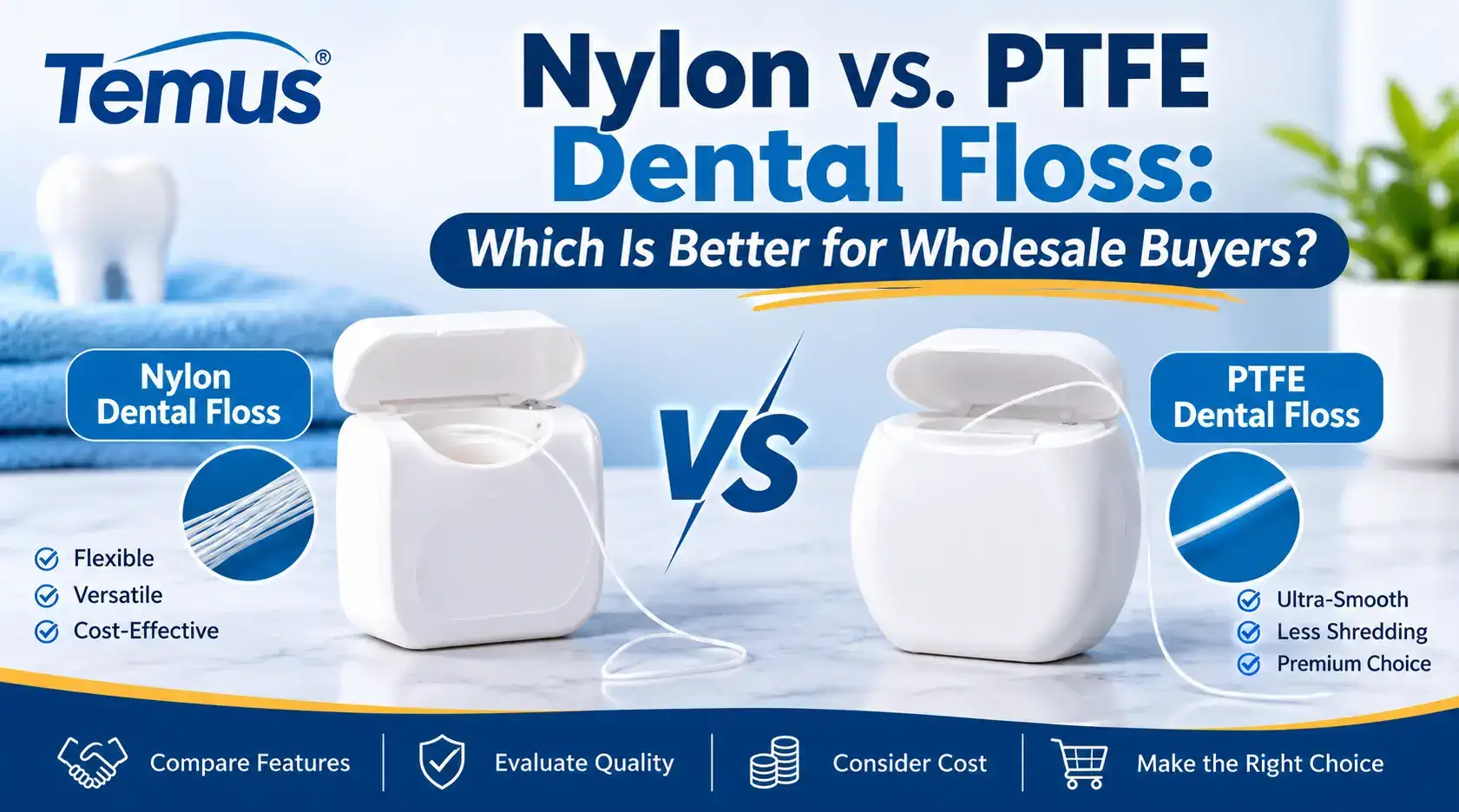
Quick Summary: Nylon and PTFE are two commonly used materials in dental floss manufacturing, but they offer different characteristics for consumers and businesses. Nylon dental floss is generally available in multiple textures and price segments, making it suitable for versatile retail product lines. PTFE dental floss offers a smooth surface and greater resistance to shredding, which can support premium product positioning.
Choosing the right dental floss material is an important decision for wholesalers, importers, and oral care brands. At Temus, we understand that commercial buyers need products that meet customer expectations while supporting competitive pricing and consistent supply. Nylon and PTFE dental floss have different material properties, which can influence product performance, manufacturing requirements, and retail positioning. Understanding these differences helps businesses make informed sourcing decisions and develop product lines that meet the needs of their target markets.
Dental Floss is an important category in the oral care market, with products available in different materials, textures, thicknesses, and packaging formats. Retailers and distributors need to understand which options are suitable for their customers before placing bulk orders. Nylon floss offers versatility across different product segments, while PTFE floss is commonly associated with a smooth flossing experience. Comparing both materials can help buyers identify suitable products, evaluate supplier quotations, and build a competitive oral care product range.
Nylon dental floss is manufactured using synthetic nylon fibers that are combined to create a thin thread for cleaning between teeth. It is one of the established materials used in dental floss production and is available in different thicknesses, textures, and coatings. Manufacturers can produce waxed and unwaxed varieties depending on product specifications and customer requirements. This flexibility makes nylon floss suitable for businesses targeting different consumer groups, retail channels, and price categories within the oral care market.
One important characteristic of nylon dental floss is its multifilament structure, which means it consists of several small fibers joined together. This construction provides flexibility and allows manufacturers to develop different product variations. However, depending on its construction and quality, nylon floss may fray or break when exposed to excessive tension or rough contact. Buyers should evaluate the material's consistency, strength, and overall finish before selecting a nylon floss product for wholesale distribution.
Nylon dental floss is available in different product configurations, allowing manufacturers to serve a wide range of commercial requirements. Waxed varieties have a coating that can help the floss move between teeth, while unwaxed versions offer a different texture and handling experience. Buyers can also explore different thread thicknesses, lengths, flavors, and container designs. These options provide opportunities for retailers and private label brands to develop product collections that match their customers' preferences and pricing expectations.
PTFE stands for Polytetrafluoroethylene, a synthetic polymer known for its low friction properties and smooth surface. In dental floss production, PTFE is used to create a thin, continuous material rather than the multiple fiber structure commonly found in nylon floss. This construction helps the floss move smoothly between closely spaced teeth. For wholesalers and distributors, PTFE dental floss can be an attractive option when targeting customers who prefer a smooth texture and a product positioned within a premium oral care range.
PTFE dental floss is also generally more resistant to shredding than conventional multifilament nylon floss. Its smooth construction can provide consistent handling during normal use, although actual performance depends on product design, thickness, manufacturing quality, and intended application. Buyers should avoid evaluating PTFE products based on material names alone. Requesting samples and reviewing technical specifications can help businesses understand whether a particular product meets their quality expectations and is appropriate for their target retail market.
The main features of PTFE dental floss include its smooth surface, low friction, and resistance to fraying. These characteristics can make it suitable for consumers who prefer floss that moves easily through tight spaces. Manufacturers may offer different lengths, thicknesses, container styles, and packaging options to meet commercial requirements. For distributors, these product variations create opportunities to serve premium oral care retailers, pharmacies, supermarkets, and brands looking to expand their existing dental hygiene collections.
Understanding the differences between nylon and PTFE dental floss can help wholesale buyers select products according to their business requirements. Both materials are used for interdental cleaning, but their construction and performance characteristics are not identical. Nylon uses multiple fibers, while PTFE generally has a continuous structure. These differences influence texture, resistance to shredding, product positioning, and available variations. Buyers should compare the following characteristics before choosing a material for their wholesale or private label product lines.
For commercial buyers, the comparison shows that neither material is automatically the best choice for every business. Nylon offers flexibility in product development and can serve different retail price segments, while PTFE provides characteristics that may appeal to premium customers. Product quality also depends on manufacturing standards, material consistency, and production processes. Importers should compare actual product samples rather than making purchasing decisions based only on general material descriptions or supplier marketing claims.
Nylon dental floss can be a suitable option for businesses targeting customers who prioritize affordability and product variety. Its availability in waxed, unwaxed, flavored, and different thickness options allows distributors to build multiple product variations. Retailers can include nylon floss in everyday oral care collections, supermarket shelves, and promotional product bundles. For importers, this versatility can help address different customer preferences while maintaining a product range that fits various retail budgets and distribution strategies.
PTFE dental floss may be more suitable for businesses targeting customers who value smoothness and resistance to shredding. Its material characteristics can support premium positioning within pharmacies, specialized oral care stores, and higher-value retail collections. Distributors can introduce PTFE floss alongside other premium dental hygiene products to create a more diverse product offering. However, buyers should consider local purchasing power, competitor products, and wholesale pricing before deciding whether premium positioning is commercially suitable for their target market.
Wholesale pricing is an important factor when choosing between nylon and PTFE dental floss. The final product cost can depend on raw material prices, production methods, thread specifications, order quantity, packaging, and customization requirements. PTFE and nylon products may have different manufacturing cost structures, but the actual price difference varies between manufacturers. Buyers should request quotations based on matching specifications so they can compare products fairly and understand the overall value offered by each supplier.
Order quantity can also influence the unit price of dental floss. Larger orders may provide opportunities for better production efficiency and more competitive pricing, depending on the manufacturer's capacity and pricing structure. Custom packaging, printed containers, private labeling, and special product requirements can increase the overall quotation. Importers should calculate the complete landed cost, including shipping, customs duties, and other applicable expenses, rather than evaluating a supplier based only on the factory price.
Before purchasing dental floss in bulk, buyers should verify the material type, thread thickness, length, strength, texture, and product finish. These specifications help ensure that the supplied product matches the intended market requirements. Businesses should request samples to evaluate how the floss performs during normal use and whether its construction is consistent. Comparing samples from different suppliers can also help buyers identify differences in product quality before committing to a large commercial order.
A manufacturer's production capacity and quality control procedures directly affect its ability to fulfill wholesale orders consistently. Buyers should ask about raw material inspection, production monitoring, finished product checks, and packaging inspections. They should also confirm whether the manufacturer can maintain the same specifications across repeat orders. Working with an experienced dental floss manufacturer can reduce sourcing uncertainty and help distributors maintain consistent product standards across different shipments and retail markets.
Minimum order quantity, commonly called MOQ, is another important consideration for importers and distributors. Some manufacturers may require higher quantities for customized packaging, special specifications, or private label production. Buyers should confirm the MOQ for each product variation before negotiating an order. They should also discuss production lead times, monthly manufacturing capacity, sample availability, and repeat order arrangements. These details help businesses plan inventory, manage purchasing budgets, and avoid unexpected delays when fulfilling customer demand.
Packaging plays an important role in how dental floss products are presented and sold in retail markets. Manufacturers may offer individual floss containers, refill packs, multipacks, and customized packaging formats. Buyers should consider container durability, ease of use, product protection, labeling space, and retail presentation when selecting packaging. The right format can help distributors serve supermarkets, pharmacies, online retailers, and specialized oral care stores with products that meet their respective packaging and merchandising requirements.
Private label manufacturing offers another opportunity for businesses looking to develop their own dental floss brands. Depending on the manufacturer's capabilities, buyers may customize container designs, brand logos, packaging artwork, product specifications, and other presentation details. OEM arrangements can also help established oral care companies expand their product collections without developing their own production facilities. Before confirming a private label order, businesses should approve product samples, artwork, packaging specifications, and labeling requirements to minimize production errors.
Choosing a reliable supplier is just as important as selecting the right floss material. Buyers should evaluate the manufacturer's experience, production equipment, quality control procedures, product range, and ability to handle bulk orders. It is also useful to check whether the supplier can provide both nylon and PTFE options, along with customized packaging. Businesses can further compare potential manufacturers by reviewing product samples, technical documentation, communication quality, and their ability to meet agreed delivery schedules.
For a more detailed supplier evaluation process, buyers can read our related article, How to Choose the Right Toothbrush Manufacturer for Your Product Line. It explains important considerations when evaluating oral care manufacturers, including product quality, production capabilities, and customization options. Businesses can also explore How to Compare Toothbrush Manufacturers for Bulk Orders to understand how to assess suppliers before making large purchasing commitments. Applying similar evaluation criteria to dental floss sourcing can support better purchasing decisions and long-term supplier relationships.
One common mistake is choosing dental floss based only on the lowest wholesale price. A low quotation does not always indicate good value, especially when the product has inconsistent thickness, weak construction, or unsuitable packaging. Buyers should compare product samples, material specifications, and quality inspection procedures before confirming an order. Another mistake is selecting a material without understanding customer preferences. A product designed for a premium market may not perform commercially well in a price-sensitive retail segment.
Importers should also avoid placing large orders without confirming product samples and production specifications. Differences between approved samples and finished bulk shipments can create quality concerns, customer complaints, and additional costs. Packaging and labeling requirements should also be discussed before production begins. Businesses can learn more about product selection and sourcing decisions through our article, What Should Buyers Check Before Purchasing Dental Floss in Bulk?, which covers important checks for commercial dental floss orders.
Nylon and PTFE dental floss both offer useful characteristics for different commercial markets. Nylon is a versatile option for businesses seeking multiple product variations and different retail price segments. PTFE may be a better fit for buyers targeting customers who prefer a smooth flossing experience and greater resistance to shredding. The right selection depends on customer expectations, product specifications, wholesale pricing, and the business's overall market positioning.
Wholesale buyers should evaluate more than the material when making their final purchasing decision. Manufacturing quality, supplier reliability, MOQ, customization options, packaging, and delivery arrangements all contribute to successful sourcing. Comparing samples and requesting detailed quotations can help businesses identify suitable products for their distribution channels. By understanding these factors, importers, retailers, and distributors can build a dental floss collection that supports customer demand and long-term commercial growth.
Nylon dental floss consists of multiple synthetic fibers, while PTFE floss generally uses a continuous material structure. This difference affects texture and resistance to shredding.
PTFE dental floss is generally more resistant to shredding than conventional multifilament nylon floss. However, overall durability depends on material quality, thickness, manufacturing processes, and product construction. Nylon products can also provide reliable performance when manufactured according to suitable quality specifications.
Nylon can be suitable for versatile product collections and different price segments, while PTFE may appeal to premium oral care customers. Distributors should consider wholesale pricing, product quality, packaging, and local demand before choosing.
Nylon dental floss is commonly available in both waxed and unwaxed varieties. Waxed floss has a coating that can help it move between teeth, while unwaxed floss provides a different texture and handling experience.
Importers should check material quality, thread specifications, product samples, manufacturing capacity, MOQ, packaging, and quality control procedures.
Many dental floss manufacturers offer private label and OEM services, depending on their production capabilities. Available options may include customized containers, brand logos, packaging designs, product lengths, and other specifications.
Material selection can influence production costs because nylon and PTFE have different raw material and manufacturing requirements.
Quick Summary: Nylon and PTFE are two commonly used materials in dental floss manufacturing, but they offer different characteristics for consumers and businesses. Nylon dental floss is generally available in multiple textures and price segments, making it suitable for versatile retail product lines. PTFE dental floss offers a smooth surface and greater resistance to shredding, which can support premium product positioning. Introduction Choosing the right dental floss material is an important decision for wholesalers, importers, and oral care brands. At Temus, we understand that commercial buyers need products that meet customer expectations while supporting competitive pricing and consistent supply. Nylon and PTFE dental floss have different material properties, which can influence product performance, manufacturing requirements, and retail positioning. Understanding these differences helps businesses make informed sourcing decisions and develop product lines that meet the needs of their target markets. Dental Floss is an important category in the oral care market, with products available in different materials, textures, thicknesses, and packaging formats. Retailers and distributors need to understand which options are suitable for their customers before placing bulk orders. Nylon floss offers versatility across different product segments, while PTFE floss is commonly associated with a smooth flossing experience. Comparing both materials can help buyers identify suitable products, evaluate supplier quotations, and build a competitive oral care product range. What Is Nylon Dental Floss? Nylon dental floss is manufactured using synthetic nylon fibers that are combined to create a thin thread for cleaning between teeth. It is one of the established materials used in dental floss production and is available in different thicknesses, textures, and coatings. Manufacturers can produce waxed and unwaxed varieties depending on product specifications and customer requirements. This flexibility makes nylon floss suitable for businesses targeting different consumer groups, retail channels, and price categories within the oral care market. One important characteristic of nylon dental floss is its multifilament structure, which means it consists of several small fibers joined together. This construction provides flexibility and allows manufacturers to develop different product variations. However, depending on its construction and quality, nylon floss may fray or break when exposed to excessive tension or rough contact. Buyers should evaluate the material's consistency, strength, and overall finish before selecting a nylon floss product for wholesale distribution. Key Features of Nylon Dental Floss Nylon dental floss is available in different product configurations, allowing manufacturers to serve a wide range of commercial requirements. Waxed varieties have a coating that can help the floss move between teeth, while unwaxed versions offer a different texture and handling experience. Buyers can also explore different thread thicknesses, lengths, flavors, and container designs. These options provide opportunities for retailers and private label brands to develop product collections that match their customers' preferences and pricing expectations. What Is PTFE Dental Floss? PTFE stands for Polytetrafluoroethylene, a synthetic polymer known for its low friction properties and smooth surface. In dental floss production, PTFE is used to create a thin, continuous material rather than the multiple fiber structure commonly found in nylon floss. This construction helps the floss move smoothly between closely spaced teeth. For wholesalers and distributors, PTFE dental floss can be an attractive option when targeting customers who prefer a smooth texture and a product positioned within a premium oral care range. PTFE dental floss is also generally more resistant to shredding than conventional multifilament nylon floss. Its smooth construction can provide consistent handling during normal use, although actual performance depends on product design, thickness, manufacturing quality, and intended application. Buyers should avoid evaluating PTFE products based on material names alone. Requesting samples and reviewing technical specifications can help businesses understand whether a particular product meets their quality expectations and is appropriate for their target retail market. Key Features of PTFE Dental Floss The main features of PTFE dental floss include its smooth surface, low friction, and resistance to fraying. These characteristics can make it suitable for consumers who prefer floss that moves easily through tight spaces. Manufacturers may offer different lengths, thicknesses, container styles, and packaging options to meet commercial requirements. For distributors, these product variations create opportunities to serve premium oral care retailers, pharmacies, supermarkets, and brands looking to expand their existing dental hygiene collections. Nylon vs. PTFE Dental Floss: Key Differences Understanding the differences between nylon and PTFE dental floss can help wholesale buyers select products according to their business requirements. Both materials are used for interdental cleaning, but their construction and performance characteristics are not identical. Nylon uses multiple fibers, while PTFE generally has a continuous structure. These differences influence texture, resistance to shredding, product positioning, and available variations. Buyers should compare the following characteristics before choosing a material for their wholesale or private label product lines. Comparison Factor Nylon Dental Floss PTFE Dental Floss Material Synthetic nylon fibers PTFE polymer Structure Multiple filaments Continuous material Surface Available in different textures Generally smooth Thickness Available in different thicknesses Available in different thicknesses Shredding Can fray or shred Generally more resistant to shredding Product varieties Waxed and unwaxed options Smooth floss varieties Market positioning Multiple price segments Often positioned as a premium option Customization Different flavors, coatings, and packaging Different lengths, thicknesses, and packaging For commercial buyers, the comparison shows that neither material is automatically the best choice for every business. Nylon offers flexibility in product development and can serve different retail price segments, while PTFE provides characteristics that may appeal to premium customers. Product quality also depends on manufacturing standards, material consistency, and production processes. Importers should compare actual product samples rather than making purchasing decisions based only on general material descriptions or supplier marketing claims. Which Dental Floss Material Is Better for Different Consumer Markets? Nylon Dental Floss for Price Competitive Markets Nylon dental floss can be a suitable option for businesses targeting customers who prioritize affordability and product variety. Its availability in waxed, unwaxed, flavored, and different thickness options allows distributors to build multiple product variations. Retailers can include nylon floss in everyday oral care collections, supermarket shelves, and promotional product bundles. For importers, this versatility can help address different customer preferences while maintaining a product range that fits various retail budgets and distribution strategies. PTFE Dental Floss for Premium Oral Care Markets PTFE dental floss may be more suitable for businesses targeting customers who value smoothness and resistance to shredding. Its material characteristics can support premium positioning within pharmacies, specialized oral care stores, and higher-value retail collections. Distributors can introduce PTFE floss alongside other premium dental hygiene products to create a more diverse product offering. However, buyers should consider local purchasing power, competitor products, and wholesale pricing before deciding whether premium positioning is commercially suitable for their target market. Cost and Wholesale Pricing Considerations for Buyers Wholesale pricing is an important factor when choosing between nylon and PTFE dental floss. The final product cost can depend on raw material prices, production methods, thread specifications, order quantity, packaging, and customization requirements. PTFE and nylon products may have different manufacturing cost structures, but the actual price difference varies between manufacturers. Buyers should request quotations based on matching specifications so they can compare products fairly and understand the overall value offered by each supplier. Order quantity can also influence the unit price of dental floss. Larger orders may provide opportunities for better production efficiency and more competitive pricing, depending on the manufacturer's capacity and pricing structure. Custom packaging, printed containers, private labeling, and special product requirements can increase the overall quotation. Importers should calculate the complete landed cost, including shipping, customs duties, and other applicable expenses, rather than evaluating a supplier based only on the factory price. What Should Wholesale Buyers Check Before Ordering Dental Floss? Material Quality and Product Specifications Before purchasing dental floss in bulk, buyers should verify the material type, thread thickness, length, strength, texture, and product finish. These specifications help ensure that the supplied product matches the intended market requirements. Businesses should request samples to evaluate how the floss performs during normal use and whether its construction is consistent. Comparing samples from different suppliers can also help buyers identify differences in product quality before committing to a large commercial order. Manufacturing Capacity and Quality Control A manufacturer's production capacity and quality control procedures directly affect its ability to fulfill wholesale orders consistently. Buyers should ask about raw material inspection, production monitoring, finished product checks, and packaging inspections. They should also confirm whether the manufacturer can maintain the same specifications across repeat orders. Working with an experienced dental floss manufacturer can reduce sourcing uncertainty and help distributors maintain consistent product standards across different shipments and retail markets. MOQ and Bulk Production Capacity Minimum order quantity, commonly called MOQ, is another important consideration for importers and distributors. Some manufacturers may require higher quantities for customized packaging, special specifications, or private label production. Buyers should confirm the MOQ for each product variation before negotiating an order. They should also discuss production lead times, monthly manufacturing capacity, sample availability, and repeat order arrangements. These details help businesses plan inventory, manage purchasing budgets, and avoid unexpected delays when fulfilling customer demand. Packaging and Private Label Opportunities for Dental Floss Packaging plays an important role in how dental floss products are presented and sold in retail markets. Manufacturers may offer individual floss containers, refill packs, multipacks, and customized packaging formats. Buyers should consider container durability, ease of use, product protection, labeling space, and retail presentation when selecting packaging. The right format can help distributors serve supermarkets, pharmacies, online retailers, and specialized oral care stores with products that meet their respective packaging and merchandising requirements. Private label manufacturing offers another opportunity for businesses looking to develop their own dental floss brands. Depending on the manufacturer's capabilities, buyers may customize container designs, brand logos, packaging artwork, product specifications, and other presentation details. OEM arrangements can also help established oral care companies expand their product collections without developing their own production facilities. Before confirming a private label order, businesses should approve product samples, artwork, packaging specifications, and labeling requirements to minimize production errors. How to Choose the Right Dental Floss Manufacturer or Supplier? Choosing a reliable supplier is just as important as selecting the right floss material. Buyers should evaluate the manufacturer's experience, production equipment, quality control procedures, product range, and ability to handle bulk orders. It is also useful to check whether the supplier can provide both nylon and PTFE options, along with customized packaging. Businesses can further compare potential manufacturers by reviewing product samples, technical documentation, communication quality, and their ability to meet agreed delivery schedules. For a more detailed supplier evaluation process, buyers can read our related article, How to Choose the Right Toothbrush Manufacturer for Your Product Line. It explains important considerations when evaluating oral care manufacturers, including product quality, production capabilities, and customization options. Businesses can also explore How to Compare Toothbrush Manufacturers for Bulk Orders to understand how to assess suppliers before making large purchasing commitments. Applying similar evaluation criteria to dental floss sourcing can support better purchasing decisions and long-term supplier relationships. Common Mistakes Buyers Should Avoid When Sourcing Dental Floss One common mistake is choosing dental floss based only on the lowest wholesale price. A low quotation does not always indicate good value, especially when the product has inconsistent thickness, weak construction, or unsuitable packaging. Buyers should compare product samples, material specifications, and quality inspection procedures before confirming an order. Another mistake is selecting a material without understanding customer preferences. A product designed for a premium market may not perform commercially well in a price-sensitive retail segment. Importers should also avoid placing large orders without confirming product samples and production specifications. Differences between approved samples and finished bulk shipments can create quality concerns, customer complaints, and additional costs. Packaging and labeling requirements should also be discussed before production begins. Businesses can learn more about product selection and sourcing decisions through our article, What Should Buyers Check Before Purchasing Dental Floss in Bulk?, which covers important checks for commercial dental floss orders. Final Verdict: Nylon vs. PTFE Dental Floss, Which Should Wholesale Buyers Choose? Nylon and PTFE dental floss both offer useful characteristics for different commercial markets. Nylon is a versatile option for businesses seeking multiple product variations and different retail price segments. PTFE may be a better fit for buyers targeting customers who prefer a smooth flossing experience and greater resistance to shredding. The right selection depends on customer expectations, product specifications, wholesale pricing, and the business's overall market positioning. Wholesale buyers should evaluate more than the material when making their final purchasing decision. Manufacturing quality, supplier reliability, MOQ, customization options, packaging, and delivery arrangements all contribute to successful sourcing. Comparing samples and requesting detailed quotations can help businesses identify suitable products for their distribution channels. By understanding these factors, importers, retailers, and distributors can build a dental floss collection that supports customer demand and long-term commercial growth. Frequently Asked Questions (FAQs) 1. What Is the Main Difference Between Nylon and PTFE Dental Floss? Nylon dental floss consists of multiple synthetic fibers, while PTFE floss generally uses a continuous material structure. This difference affects texture and resistance to shredding. 2. Is PTFE Dental Floss More Durable Than Nylon Dental Floss? PTFE dental floss is generally more resistant to shredding than conventional multifilament nylon floss. However, overall durability depends on material quality, thickness, manufacturing processes, and product construction. Nylon products can also provide reliable performance when manufactured according to suitable quality specifications. 3. Which Dental Floss Material Is More Suitable for Wholesale Buyers? Nylon can be suitable for versatile product collections and different price segments, while PTFE may appeal to premium oral care customers. Distributors should consider wholesale pricing, product quality, packaging, and local demand before choosing. 4. Is Nylon Dental Floss Available in Waxed and Unwaxed Options? Nylon dental floss is commonly available in both waxed and unwaxed varieties. Waxed floss has a coating that can help it move between teeth, while unwaxed floss provides a different texture and handling experience. 5. What Should Importers Check Before Purchasing Dental Floss in Bulk? Importers should check material quality, thread specifications, product samples, manufacturing capacity, MOQ, packaging, and quality control procedures. 6. Can Manufacturers Provide Private Label Nylon and PTFE Dental Floss? Many dental floss manufacturers offer private label and OEM services, depending on their production capabilities. Available options may include customized containers, brand logos, packaging designs, product lengths, and other specifications. 7. How Does Dental Floss Material Affect Wholesale Pricing? Material selection can influence production costs because nylon and PTFE have different raw material and manufacturing requirements.
READ FULLPurchasing dental floss in bulk requires careful planning, especially for importers, wholesalers, retailers, and oral care distributors who want to maintain consistent product quality and competitive pricing. Temus understands the importance of offering reliable oral care products that meet different market requirements. Before placing a large order, buyers should evaluate dental floss materials, product types, manufacturing quality, packaging, customization options, and supplier capabilities. These factors help businesses make informed purchasing decisions, manage inventory, and build a competitive oral care product line. 1. Check the Different Types of Dental Floss Available Dental floss is available in different types, and each option serves different customer preferences and oral care requirements. Buyers should understand these differences before selecting products for wholesale distribution. Offering multiple dental floss varieties can help retailers reach customers with different needs. For example, some customers prefer waxed floss because it moves more easily between teeth, while others choose unwaxed floss for its thinner texture. Selecting suitable varieties can help businesses develop a more attractive oral care product range. Common types of dental floss include: Waxed Dental Floss: Coated with wax to help the thread move between teeth more easily. Unwaxed Dental Floss: Usually thinner and has no wax coating, making it suitable for customers who prefer a different flossing feel. PTFE Dental Floss: Made from polytetrafluoroethylene, this type is designed to glide smoothly between teeth. Nylon Dental Floss: A traditional option made from multiple nylon filaments, available in different thicknesses and textures. Dental Tape: A wider and flatter alternative that some customers prefer for cleaning between teeth. Flavored Dental Floss: Available in flavors such as mint to provide a fresh feeling during use. For commercial buyers, the right product selection depends on target customers, retail positioning, and local market demand. Reviewing these options before purchasing dental floss in bulk can help distributors avoid unnecessary inventory and select products that fit their business requirements. 2. Evaluate Dental Floss Material and Product Quality Material quality is one of the most important factors when purchasing dental floss in bulk. The material affects the product's flexibility, strength, thickness, and performance during everyday use. Buyers should ask manufacturers about the materials used in production and request detailed product specifications. Nylon and PTFE are common materials, but their properties differ. Understanding these differences allows wholesalers and retailers to compare products more accurately and select suitable options for their intended customer groups. When evaluating dental floss materials, buyers should consider the following factors: Tensile Strength: Check whether the floss can withstand normal use without breaking easily. Flexibility: Evaluate whether the thread can move comfortably between teeth. Surface Texture: Check whether the material has a smooth or rough texture. Thickness: Compare different thicknesses to understand their intended applications. Material Consistency: Ensure that the floss maintains consistent quality throughout the production batch. Product quality should also be evaluated through physical samples rather than specifications alone. Buyers can test how the floss feels, whether it separates during use, and how easily it moves through a floss dispenser. These checks help businesses identify potential quality issues before committing to larger orders. Consistent materials and manufacturing standards are especially important for distributors who plan to purchase the same dental floss products repeatedly. Read this blog: How to Choose the Right Toothbrush Manufacturer for Your Product Line 3. Check Manufacturing Quality and Product Consistency Manufacturing quality directly affects the reliability of dental floss products supplied to wholesalers and retailers. When businesses purchase large quantities, even small production differences can create problems across an entire order. Buyers should evaluate how manufacturers control material selection, thread production, cutting, winding, and final packaging. A reliable manufacturing process helps maintain consistent product specifications and reduces the possibility of receiving products with different thicknesses, weak threads, or dispensing problems. Before confirming an order, ask the manufacturer about its quality control procedures. Important manufacturing checks include: Inspection of incoming raw materials before production. Monitoring thread thickness and material uniformity. Checking thread strength and resistance to breaking. Reviewing winding accuracy inside floss dispensers. Inspecting cutting quality and product finishing. Checking finished products before packaging and shipment. Buyers should also ask whether manufacturers maintain batch records and documented inspection procedures. These records can help businesses investigate quality complaints and compare different production batches. For distributors supplying supermarkets, pharmacies, and retail chains, consistent product quality supports customer confidence and reduces the risk of product returns. It is also useful to establish clear specifications before production begins so that the manufacturer understands the required standards for every order. Read this blog: Soft, Medium, or Hard? How to Choose the Right Toothbrush Bristle Firmness 4. Review Dental Floss Packaging Options Packaging is another important consideration when purchasing dental floss in bulk because it affects product protection, storage, transportation, and retail presentation. Buyers should review the available packaging formats according to their target markets and sales channels. Dental floss is commonly available in compact dispensers, refill packs, and containers designed for floss picks. Each format serves a different purchasing purpose. For example, individual dispensers may be suitable for supermarket shelves, while refill packs can appeal to customers looking for replacement floss. Consider these packaging factors before selecting a product: Packaging Material: Check whether the packaging protects the floss from dust, moisture, and physical damage. Dispenser Design: Evaluate whether customers can pull and cut the floss conveniently. Product Size: Compare floss lengths and container dimensions. Labeling: Check whether product information, material details, and usage instructions are clearly displayed. Retail Presentation: Review packaging appearance, colors, and shelf visibility. Transportation: Ensure that packaging can withstand normal handling during storage and shipping. Businesses should also consider packaging requirements in their destination markets. Importers may need specific product information, language translations, manufacturer details, or barcode arrangements. Reviewing these requirements before production can help prevent delays and additional packaging expenses. A suitable packaging format should balance product protection, customer convenience, storage efficiency, and the commercial needs of the retailer or distributor. 5. Compare Dental Floss Suppliers and Manufacturers Selecting the right supplier is essential for businesses that want to maintain a stable supply of dental floss. A manufacturer may offer attractive prices, but buyers should also evaluate production capacity, product variety, communication, and experience in handling wholesale orders. Comparing multiple suppliers can help businesses understand differences in product specifications, manufacturing capabilities, and commercial terms. Rather than choosing a manufacturer based on price alone, importers should consider whether the supplier can support their purchasing requirements over the long term. When comparing dental floss manufacturers, review these important points: Manufacturing Experience: Check how long the company has been producing oral care products. Production Capacity: Evaluate whether it can handle your required order volume. Product Range: Check the availability of waxed, unwaxed, PTFE, nylon, and flavored floss. Quality Procedures: Ask about inspection methods and product testing. Communication: Evaluate how clearly the supplier responds to technical and commercial questions. Order Support: Check whether the manufacturer can support repeat orders and product customization. It is also useful to request product catalogs, specifications, and manufacturing information before making a decision. Buyers should verify company details and review relevant business documentation wherever possible. A supplier that communicates clearly and provides accurate product information can make the purchasing process easier. Establishing a reliable business relationship is particularly valuable for distributors that need regular shipments and consistent product specifications. 6. Understand MOQ, Bulk Pricing, and Order Requirements Minimum order quantity (MOQ) and pricing directly affect the purchasing budget of wholesalers, importers, and distributors. Different manufacturers may offer different MOQs depending on product types, packaging formats, materials, and customization requirements. Buyers should understand these conditions before placing an order. A low unit price may appear attractive, but the total purchasing cost can increase when additional expenses such as packaging, transportation, testing, and customization are included. Before confirming bulk pricing, evaluate the following commercial factors: Minimum Order Quantity: Check the minimum number of units required for each product. Unit Price: Compare prices at different purchasing volumes. Sample Charges: Ask whether product samples involve additional costs. Customization Expenses: Review charges for custom packaging, printing, and branding. Payment Terms: Understand the deposit requirements and remaining payment schedule. Shipping Costs: Include freight, insurance, and other applicable logistics expenses. Production Time: Confirm how long the manufacturer needs to complete the order. Buyers should calculate the total landed cost rather than comparing only the factory price. This includes the product cost, shipping, customs duties, taxes, and other relevant expenses. It is also important to avoid purchasing more stock than the business can reasonably sell. A balanced order quantity can help distributors manage cash flow, reduce storage pressure, and maintain enough inventory to meet customer demand. Read this blog: How to Compare Toothbrush Manufacturers for Bulk Orders 7. Explore Private Label and Customization Opportunities Private label dental floss allows retailers and distributors to sell products under their own business names. This option can help companies develop a recognizable oral care brand without establishing their own manufacturing facilities. Many manufacturers provide customization services that include logo printing, dispenser designs, packaging layouts, and product specifications. Before selecting a private label option, buyers should understand which customization features are available and whether the supplier can maintain consistent production standards across future orders. Common customization opportunities include: Custom Branding: Add your company logo and brand name to the packaging. Packaging Design: Select colors, graphics, and layouts that match your brand identity. Floss Types: Choose suitable waxed, unwaxed, nylon, or PTFE options. Flavors: Explore available flavors based on target customer preferences. Dispenser Designs: Compare different shapes, sizes, and cutting mechanisms. Packaging Quantities: Select suitable floss lengths and pack sizes for retail distribution. Importers should also discuss customization costs, artwork approval, production timelines, and MOQ requirements before starting the process. Requesting a packaging sample or digital design proof can help avoid mistakes in the final product. Businesses should ensure that all product claims and labeling information are accurate. A well-planned private label strategy can help retailers differentiate their products and build stronger brand recognition in competitive oral care markets. 8. Verify Product Documentation and Market Requirements Product documentation is an important part of international dental floss purchasing, especially for businesses importing oral care products into different countries. Buyers should understand the applicable regulatory and labeling requirements in their destination markets before confirming production. Requirements can vary depending on product classification, materials, packaging, and intended use. Manufacturers should be able to provide relevant technical information and supporting documents that help buyers evaluate whether the products meet their purchasing and compliance requirements. Before placing an order, consider requesting the following information: Product specifications and material details. Available quality inspection reports. Relevant product safety or testing documentation. Manufacturing and supplier information. Packaging and labeling details. Applicable conformity or compliance documents. Importers should independently verify whether the supplied documents meet the requirements of their destination countries. Do not assume that one certificate or testing report automatically satisfies every market's regulations. Buyers should also review product descriptions and marketing claims to ensure they are supported by appropriate evidence. Checking documentation early can reduce the risk of customs issues, labeling corrections, and unexpected delays during international distribution. Read this blog: How to Choose the Right Toothbrush for Your Product Line: A Guide for Bulk Buyers 9. Request Samples Before Placing a Bulk Order Requesting product samples is a practical step before purchasing dental floss in large quantities. Product descriptions and photographs can explain basic specifications, but they cannot fully demonstrate how the floss performs during use. Samples allow buyers to examine material quality, thread strength, flexibility, packaging, and dispenser functionality. This process is particularly useful when comparing different manufacturers or introducing a new dental floss product to an existing oral care range. When reviewing samples, pay attention to these areas: Check whether the floss breaks or separates easily. Evaluate how smoothly it moves between teeth. Compare the thickness and texture with the agreed specifications. Test whether the dispenser releases the floss properly. Review the cutting mechanism and overall packaging quality. Check whether product labels match the supplied specifications. After evaluating samples, buyers should document their preferred product specifications and share them with the manufacturer. This helps create a clear reference for the final production order. Businesses should also confirm that mass-produced products will match the approved sample in terms of material, packaging, and performance. Sample approval is a useful quality control step that can help reduce misunderstandings and purchasing risks. 10. Evaluate Shipping, Lead Times, and Long-Term Supply Shipping and production timelines are important considerations for businesses purchasing dental floss internationally. Even when a manufacturer offers suitable products and competitive prices, delayed deliveries can affect inventory planning and customer commitments. Buyers should understand the expected production schedule, order processing time, packaging preparation, and shipping arrangements before confirming a purchase. Clear communication about delivery expectations can help importers plan stock levels and coordinate distribution more effectively. Consider these logistics factors when evaluating a supplier: Production Lead Time: Confirm the estimated manufacturing period. Shipping Method: Compare available air, sea, and other suitable freight options. Delivery Schedule: Discuss estimated transit times and shipment arrangements. Packaging Protection: Check whether products are packed appropriately for transportation. Inventory Planning: Coordinate purchasing schedules with expected sales demand. Repeat Orders: Confirm whether the manufacturer can support regular replenishment. Long-term supply reliability is particularly important for wholesalers and distributors that serve multiple retail customers. Buyers should discuss future production capacity and the possibility of repeat orders before establishing a business relationship. Maintaining communication with suppliers can also help businesses respond to changes in demand. A well-organized purchasing and shipping plan supports inventory availability and helps reduce unnecessary supply chain disruptions. Conclusion: Choose the Right Dental Floss Supplier for Your Business Purchasing dental floss in bulk involves more than comparing product prices or selecting a popular floss type. Buyers should evaluate materials, manufacturing quality, packaging, supplier reliability, customization opportunities, documentation, and shipping arrangements. Requesting samples and confirming specifications before production can also help reduce purchasing risks. For importers, wholesalers, and retailers, these steps provide a practical approach to selecting products that meet customer expectations while supporting business requirements and long-term inventory planning. Temus focuses on oral care product solutions for businesses looking to develop and expand their product ranges. When evaluating dental floss sourcing opportunities, buyers should prioritize consistent product quality, suitable packaging, and reliable manufacturing support. Working with an experienced oral care supplier can help businesses manage bulk purchasing requirements and explore customization opportunities. By evaluating these factors carefully, distributors and retailers can make better sourcing decisions and build a competitive dental care product line.
READ FULLFor importers, wholesalers, distributors, retailers, and private label brands, choosing the right toothbrush products is an important part of building a competitive product line. TEMUS provides toothbrush solutions for businesses looking to develop suitable products for their target markets. Bulk purchasing requires more than comparing prices between suppliers. Buyers also need to consider the target market, toothbrush type, bristle firmness, brush head, handle design, product quality, packaging, customization, MOQ, and production capacity. A suitable product range should meet customer expectations while also supporting your pricing and distribution strategy. By reviewing these factors before placing an order, bulk buyers can reduce product selection mistakes and build a more practical toothbrush range for their market. 1. Start by Defining Your Target Toothbrush Market Before selecting individual toothbrush models, bulk buyers should first understand the customers they want to serve. Different customer groups can have different expectations regarding toothbrush size, bristle firmness, design, packaging, and price. A retailer selling everyday personal care products may need a broad range of affordable toothbrushes, while a hotel supplier may focus more on simple packaging and large volume orders. Defining the target market first makes it easier to select products that have a clear purpose within your overall product line. Identify Your Main Customer Group The first step is to identify the main customer group for your toothbrush products. Your customers may include adults, children, families, hotels, dental clinics, supermarkets, pharmacies, online retailers, or promotional product buyers. Each segment can require different product specifications and price points. For example, children's toothbrushes normally require different dimensions and designs than adult toothbrushes, while hotel buyers may prioritize simple packaging, consistent supply, and competitive bulk pricing. Understanding the customer group helps you avoid selecting products without a clear market purpose. Understand the Price Range of Your Market Price positioning is another important factor when developing a toothbrush product line. Some markets focus heavily on affordable everyday products, while others have customers who are willing to pay more for improved design, packaging, customization, or other product features. Bulk buyers should understand the expected retail price before selecting products because the purchase price must leave enough room for shipping, distribution, marketing, and retailer margins. A product that looks attractive at the factory level may not be suitable if its final selling price is too high for the target market. Match the Product With Customer Demand Your product selection should also be based on actual customer demand rather than simply choosing every available toothbrush model. Importers and distributors can review previous sales, customer feedback, competitor products, market trends, and retailer requirements to identify useful product categories. If customers mainly purchase affordable family toothbrushes, adding many premium models may create unnecessary inventory. A balanced product line should include products with clear differences in design, features, price, or target customer so that every SKU has a practical purpose. 2. Choose the Right Toothbrush Type for Your Product Line Once the target market is clear, buyers can decide which toothbrush types should be included in the product range. A successful product line does not necessarily need dozens of similar models. Instead, buyers should select toothbrushes that cover important customer needs and different market positions. Depending on the business, the range may include adult toothbrushes, kids' toothbrushes, specialty products, promotional toothbrushes, or customized models. Selecting the right mix can help distributors manage inventory while giving retailers enough variety to serve different customer groups. Adult Toothbrushes Adult toothbrushes can form the main part of a general retail or wholesale product range. Buyers can compare different head sizes, bristle firmness options, handle designs, colors, and packaging styles when selecting these products. Basic adult toothbrushes can target price-sensitive consumers, while ergonomic handles, improved designs, or customized packaging can help create mid-range and premium options. Instead of selecting several models that look almost identical, distributors should choose adult toothbrushes that have meaningful differences and are designed for specific customer preferences or price segments. Kids Toothbrushes Kids' toothbrushes can be an important category for retailers and distributors serving families. These products generally use smaller dimensions and designs suitable for younger users, with features such as smaller brush heads, soft bristles, easy grip handles, and attractive colors. Depending on the target market, buyers may also consider age-specific designs and customized packaging. When adding children's toothbrushes to a product line, distributors should make sure the products have clear differences from adult models and meet the relevant product and market requirements. Specialty and Promotional Toothbrushes Specialty and promotional toothbrushes can provide additional opportunities for businesses that serve hotels, clinics, events, travel businesses, and promotional campaigns. These products may be selected based on packaging, branding, size, design, or specific customer requirements rather than standard retail demand. For example, a hotel supplier may need simple individually packed toothbrushes for guest rooms, while a promotional buyer may require logo printing and customized colors. Understanding the intended application helps buyers choose specialty products that fit their sales channels without creating unnecessary inventory. 3. Select the Right Bristle Firmness Bristle firmness is one of the most important product specifications when selecting toothbrushes for a wholesale or retail range. Different customers may prefer different brushing experiences, so distributors should understand the available firmness options before finalizing their product mix. Buyers should also consider how bristle firmness fits their target market, product positioning, and customer expectations. Instead of treating firmness as a minor specification, it should be included in the product selection process and clearly defined in the product specifications provided to the manufacturer. Soft Toothbrush Bristles Soft bristles can be an important option for product lines aimed at customers who prefer a gentler brushing experience. When selecting soft bristle toothbrushes, buyers should also check the consistency of the bristle trimming, attachment, overall finishing, and product quality. A soft bristle product should still provide consistent manufacturing quality across the order. For distributors, adding a clearly defined soft bristle option can help create product variety without requiring a completely different toothbrush design for every customer segment. Medium Toothbrush Bristles Medium bristles can be considered for general-purpose toothbrush products and may fit mainstream retail ranges depending on the requirements of the target market. Bulk buyers should still review the exact specifications and intended positioning before choosing this option. When comparing medium bristle toothbrushes from different manufacturers, buyers should pay attention to bristle consistency, trimming, attachment, head design, and overall product finishing. These details can influence how the finished product looks and feels when it reaches retailers and end customers. Hard Toothbrush Bristles Hard bristles should be considered carefully as part of a toothbrush product strategy. Buyers should understand the expectations of their target market and the applicable product requirements before adding such products to a range. The purpose should not be to offer every possible firmness simply to increase the number of SKUs. Instead, distributors should select products that have a clear market purpose and can be supported by appropriate specifications, quality checks, and customer information. For a more detailed discussion of bristle selection, buyers can review Soft, Medium, or Hard? How to Choose the Right Toothbrush Bristle Firmness. This article can provide additional information about comparing different bristle firmness options, while this product selection article focuses on how that decision fits into the wider B2B purchasing process. 4. Compare Toothbrush Head Designs and Sizes The toothbrush head is another important factor that bulk buyers should consider before placing an order. Different head sizes and shapes can help create product variation within a range, but buyers should avoid adding multiple models that provide almost the same customer value. Head dimensions, shape, bristle arrangement, and overall design should match the intended product positioning. Retailers and distributors should also make sure that the selected specifications are clearly communicated to the manufacturer so that production remains consistent across future orders. Standard Toothbrush Heads Standard toothbrush heads can work well for general retail products and value-focused product lines. They can provide a familiar design for customers while allowing buyers to focus on other specifications such as bristle firmness, handle design, color, and packaging. For distributors, standard head designs can also simplify product selection when the goal is to build a practical range with competitive pricing. However, buyers should still review the actual sample before approving production to confirm the head size, finishing, bristle arrangement, and overall quality. Compact Toothbrush Heads Compact toothbrush heads can provide another product variation for buyers who want to offer different design options. These products may be positioned differently from standard models and can help a retailer create a more diverse range without changing every product specification. When considering compact designs, bulk buyers should evaluate the head dimensions, bristle arrangement, handle balance, packaging requirements, and target customer. The important point is to choose a compact model because it serves a specific market need rather than simply adding another SKU. Head Shape and Bristle Arrangement The shape of the brush head and the arrangement of the bristles can also influence product differentiation. Buyers may encounter different head shapes, bristle layouts, trimming styles, and design options when comparing manufacturers. Instead of focusing only on appearance, importers should define the specifications they require and evaluate samples before approving a large order. Consistency is particularly important for repeat orders because retailers and distributors need the same product specifications to remain stable across different production batches. Product Feature Basic Product Mid-Range Product Premium Product Head Design Standard Improved shape Specialized design Bristles Standard options Multiple options Advanced arrangement Handle Basic Improved grip Premium ergonomic design Packaging Simple Retail packaging Premium packaging Target Market Mass market General retail Premium customers 5. Choose the Right Toothbrush Handle Design and Material The toothbrush handle is another major product selection factor because it affects appearance, grip, differentiation, and overall product positioning. A simple handle may be suitable for an economy product, while a more carefully designed handle can support a mid-range or premium product. Bulk buyers should consider the handle shape, grip area, material, surface finishing, color options, and customization possibilities. These details should be included in the product specification so that the manufacturer understands exactly what is expected before production begins. Consider Handle Shape and Grip Handle shape and grip can help differentiate toothbrushes within the same product category. Buyers can compare straight handles, ergonomic designs, grip sections, different lengths, and other available options depending on the manufacturer's capabilities. When reviewing samples, distributors should look at the overall finishing and consistency of the handle rather than judging the design from product images alone. If a retailer plans to position a toothbrush as a more premium product, the handle should support that positioning through its design, finishing, packaging, and overall presentation. Compare Handle Materials Bulk buyers should also ask manufacturers about the materials used for the toothbrush handle and the relevant product specifications. Material selection can affect appearance, durability, manufacturing cost, and customization options. Rather than selecting a material only because it is inexpensive, buyers should consider whether it fits the intended product positioning and market requirements. Samples can help buyers evaluate the handle's surface, finishing, strength, shape consistency, and overall appearance before making a large purchasing commitment. Match Handle Design With Your Brand Position The handle design should support the overall brand and product positioning. A simple handle with standard colors may work well for a value-focused product, while a customized shape, branded color, or improved grip can help differentiate a private label range. Buyers should consider the complete product rather than evaluating the handle separately. The handle, bristles, brush head, packaging, colors, and branding should create a consistent product identity that makes sense for the target retail market. 6. Consider Toothbrush Quality Before Ordering in Bulk Product quality should be evaluated before a large toothbrush order is placed because quality problems can become expensive when multiplied across thousands of units. Bulk buyers should establish clear quality expectations and communicate them to the manufacturer before production. Important areas can include bristle attachment, trimming, handle finishing, dimensions, color consistency, packaging, and general appearance. A clear quality standard also makes it easier to compare samples from different manufacturers and decide which supplier can consistently meet the required specifications. Check Bristle Quality and Attachment Bristle quality should be checked carefully during sample evaluation. Buyers can review whether the bristles are consistently trimmed, properly attached, and evenly arranged according to the agreed product specification. Any visible defects should be discussed with the manufacturer before production approval. For repeat orders, distributors should also ask how the manufacturer maintains consistency between production batches. Consistent bristle quality is particularly important for retailers because noticeable differences between products can affect customer satisfaction and create problems with product returns or complaints. Inspect Handle Quality Handle quality should also be evaluated before approving a bulk order. Buyers should inspect the surface finishing, handle shape, grip area, dimensions, color consistency, and visible defects. If the product has a customized handle, the sample should be compared carefully with the approved design. Importers should also check several samples rather than relying on a single unit because one sample may not show the consistency of an entire production batch. A broader sample review gives buyers a better understanding of manufacturing quality. Request Samples Before Bulk Production Requesting product samples is an important step before placing a large order. Samples allow buyers to evaluate the actual toothbrush rather than making decisions based only on photographs, descriptions, or quotations. Importers can compare samples against their required specifications and identify changes before production begins. If the toothbrush includes customized colors, branding, packaging, or special design requirements, sample approval becomes even more important. The final approved sample should serve as a clear reference for the production order. 7. Decide Whether You Need Standard or Customized Toothbrushes Bulk buyers should decide early whether standard products or customized toothbrushes are more suitable for their business. Standard models can simplify purchasing and may be appropriate for distributors who want established products with straightforward specifications. Customized toothbrushes can provide stronger brand differentiation but may require additional planning, higher MOQs, customized packaging, and longer preparation. The right choice depends on order volume, target market, budget, branding goals, and the manufacturer's ability to support the required customization. When Standard Toothbrushes Make Sense Standard toothbrushes can be useful when buyers want a simpler purchasing process, faster product selection, and established product designs. They may also work well for distributors who are testing a new market or adding toothbrushes to an existing product range. Standard products can reduce the need for extensive product development and customization. However, buyers should still evaluate samples, quality, MOQ, packaging, pricing, and supply capacity before placing an order, because standard products can still differ significantly between manufacturers. When Custom Toothbrushes Are Better Customized toothbrushes can be a better option for brands and retailers that want to create a more distinctive product range. Depending on the manufacturer's capabilities, customization may include handle colors, handle designs, logo printing, bristle colors, packaging, and other product details. Customization can help a brand create a consistent identity across its personal care products. However, buyers should understand the minimum order requirements, production process, approval stages, and additional costs before requesting a customized product. Consider Your Expected Order Volume Order volume should be considered before choosing customization. A small buyer may find that a fully customized toothbrush requires a higher MOQ than the business can comfortably sell, while a large distributor may benefit from customized products because the order volume can support the additional production requirements. Buyers should discuss MOQ, tooling or development requirements, packaging quantities, lead times, and repeat order expectations with the manufacturer before finalizing the product specifications. 8. Compare Toothbrush Packaging Options Packaging can influence how a toothbrush is displayed, transported, and sold. For retail products, packaging also provides space for branding, product information, barcodes, and other market-specific details. Bulk buyers should therefore consider packaging at the same time as the toothbrush itself instead of treating it as a final step. The packaging format should match the target market, distribution channel, product price, and branding strategy. Buyers should also confirm packaging dimensions and quantities because these details can affect shipping and storage requirements. Individual Toothbrush Packaging Individual packaging can be useful for retail toothbrushes and products that need separate presentation. Depending on the market, buyers may consider different packaging formats such as boxes, sleeves, or other retail packaging options. The packaging should protect the product while presenting the brand and required product information clearly. Before approving production, buyers should review the packaging sample along with the toothbrush because the final package should match the product dimensions and maintain a professional appearance. Multi Pack and Family Packaging Multi-pack packaging can be useful for supermarkets, family-focused retailers, and distributors targeting customers who prefer purchasing several toothbrushes together. Buyers can use different pack sizes to create additional product options without developing completely different toothbrush designs. However, distributors should consider whether the expected sales volume supports each pack size. Too many packaging variations can increase SKU complexity, storage requirements, and inventory management challenges, so each format should have a clear commercial purpose. Private Label Packaging Private label packaging can help retailers and brands build a stronger identity around their toothbrush products. Buyers may customize packaging with their brand name, logo, colors, product information, barcode, and other required details. Before production, the buyer should approve the packaging design and confirm that all required information is correct. It is also important to discuss MOQ and lead time because customized packaging may require additional production planning compared with standard packaging. 9. Check MOQ, Pricing, and Production Capacity Pricing is important for bulk buyers, but the lowest unit price should not be the only factor used to select a toothbrush supplier. The final purchasing cost can include the toothbrush itself, customized components, packaging, printing, shipping, and other order-related expenses. Buyers should compare quotations based on the complete order requirements rather than comparing one unit price without considering product specifications. This approach provides a clearer picture of the actual cost and helps distributors protect their expected margins. Understand Minimum Order Quantity Minimum order quantity can vary depending on whether the buyer chooses a standard or customized toothbrush. Factors such as handle colors, logo printing, packaging, bristle colors, and special product designs can influence the required order quantity. Before requesting a quotation, buyers should provide clear specifications and ask for the MOQ for each option. This prevents misunderstandings later and helps the buyer determine whether the product can be managed within the planned inventory budget. Compare Total Product Cost When comparing suppliers, buyers should calculate the total expected purchasing cost rather than looking only at the quoted toothbrush price. Product specifications, packaging, customization, shipping, and order quantity can all affect the final cost. A supplier with a slightly higher unit price may still provide better value if the product quality, packaging, customization, and consistency are stronger. For distributors, the goal should be to find a suitable balance between purchase cost, product quality, customer demand, and expected selling price. Confirm Production Capacity and Lead Time Production capacity and lead time are important for businesses that expect repeat orders. A supplier may provide an attractive initial quotation but struggle to maintain the required volume during future orders. Buyers should therefore ask about normal production schedules, lead times, repeat order planning, and the ability to handle larger quantities. Confirming these details before starting a business relationship can reduce supply problems and help distributors plan inventory more accurately. 10. Evaluate Toothbrush Manufacturers Before Placing Your Order After defining the product requirements, buyers need to evaluate whether the selected manufacturer can consistently produce the required toothbrushes. Supplier evaluation should include manufacturing capabilities, product range, customization options, quality control, samples, MOQ, pricing, and production capacity. Buyers should compare manufacturers based on their ability to meet the complete order specification rather than choosing a supplier simply because it offers the lowest quotation. A reliable manufacturing relationship can become particularly important when distributors need repeat orders with consistent product specifications. Check Product Experience and Manufacturing Capabilities Buyers should review the manufacturer's product range and manufacturing capabilities before placing a bulk order. Important questions include whether the manufacturer produces the required toothbrush type, supports the needed bristle options, provides customization, and can handle the expected order volume. Buyers should also ask how product quality is checked during production. A manufacturer that clearly explains its capabilities and processes can make the purchasing process easier and reduce uncertainty during product development. Compare Samples, Specifications, and Quotations When comparing multiple manufacturers, buyers should evaluate samples alongside the written product specifications and quotations. A lower quotation is not useful if the sample does not meet the required quality level. Similarly, a high-quality sample may not be commercially suitable if the MOQ or total purchasing cost is too high. Comparing these factors together gives buyers a more complete view of each supplier and helps them choose a manufacturer that fits both product requirements and business goals. Ask the Right Questions Before Ordering Before confirming an order, buyers should ask the manufacturer several practical questions about products, production, customization, and supply. These questions can help identify possible problems before money is committed to a large order. What toothbrush types do you manufacture? What bristle options are available? What is the MOQ for standard products? What is the MOQ for customized products? Can you customize the handle and packaging? Can you provide product samples? What quality checks are performed during production? What is the expected production lead time? Can you support repeat bulk orders? Can you maintain consistent product specifications across future orders? For additional supplier evaluation information, buyers can read How to Compare Toothbrush Manufacturers for Bulk Orders. That article can provide a deeper comparison framework, while this article focuses on choosing the right products for the overall product line. 11. Use This Toothbrush Selection Checklist Before Ordering A clear selection checklist can help importers and distributors avoid missing important details before placing a bulk toothbrush order. Buyers should record the required product specifications, target market, quantity, packaging, customization, pricing, and supplier information in one document. This makes supplier comparisons easier and gives manufacturers a clear understanding of the required products. A written checklist is particularly useful when a buyer is ordering multiple toothbrush models because it reduces the risk of confusing specifications between different SKUs. Selection Factor What Bulk Buyers Should Check Target Customer Adults, children, families, clinics, hotels, and other markets Toothbrush Type Standard, kids, specialty, promotional, or customized Bristle Firmness Required firmness and available options Brush Head Size, shape, design, and bristle arrangement Handle Shape, grip, material, color, and durability Quality Bristle attachment, trimming, finishing, and consistency Customization Logo, colors, handle, bristles, and packaging Packaging Individual, multipack, retail, or private label MOQ Minimum quantity for standard and customized orders Pricing Product, packaging, customization, and shipping costs Samples Sample approval before bulk production Supplier Manufacturing capabilities and quality controls Lead Time Production and expected delivery schedule After completing the checklist, buyers should turn the information into a clear product specification before requesting final quotations. This document can include product dimensions, bristle requirements, handle design, colors, packaging, quantity, branding, and delivery expectations. Providing the same specifications to several manufacturers makes it easier to compare quotations fairly. It also gives the selected manufacturer a clear reference that can be used during sample approval and production. 12. Common Mistakes Bulk Buyers Should Avoid Bulk purchasing mistakes can become expensive because even a small product specification problem can affect a large number of units. Buyers should therefore identify common risks before placing an order. The most common problems include choosing suppliers only because of low prices, ordering too many similar products, skipping sample evaluation, ignoring MOQ, and selecting products without understanding customer demand. A structured selection process can help distributors reduce these risks and create a more manageable product range. Choosing Only Based on the Lowest Price Selecting a toothbrush supplier only because of the lowest price can create problems if product quality, packaging, lead time, or consistency does not meet expectations. A low unit price does not automatically represent better business value. Buyers should compare the complete quotation together with product samples, specifications, MOQ, customization, quality control, and production capacity. The goal should be to find a commercially suitable product that can provide consistent value throughout the business relationship. Ordering Too Many Similar Products Another common mistake is adding too many toothbrush models that have almost identical features. This can increase inventory complexity without giving customers meaningful choices. Distributors should review every SKU and ask whether it serves a different customer group, price level, design preference, or product requirement. A smaller range with clear differences can often be easier to manage than a large collection of products that compete with each other for the same customers. Skipping Sample Evaluation Skipping samples can create unnecessary risk when ordering large quantities. Product photographs and descriptions may not show details such as handle finishing, bristle attachment, dimensions, color consistency, and packaging quality. Buyers should request samples and review them carefully before approving production. If several models are being ordered, each important model should be checked against its own specifications. Sample approval can help identify changes before they become expensive production problems. Ignoring MOQ and Repeat Order Requirements Buyers should consider not only the first order but also how the product will be purchased in the future. A product with a high MOQ may create inventory problems if sales are slower than expected. Similarly, a supplier that cannot support repeat orders may create supply gaps later. Before approving a product, buyers should understand the MOQ, lead time, production capacity, and expected repeat order process so that the product can remain commercially practical. Choosing Products Without Understanding the Target Market A toothbrush can be well manufactured and still perform poorly if it does not match customer expectations. Buyers should understand the target market before selecting products, including preferred price levels, designs, packaging, product types, and purchasing habits. A product designed for premium retail may not work well in a price-sensitive market, while a basic product may not meet the expectations of a premium brand. Product selection should always begin with the customer and market requirements. 13. Build a Balanced Toothbrush Product Line A balanced toothbrush product line should provide customers with useful choices without creating unnecessary SKU complexity. Instead of selecting many products that differ only slightly, distributors can create clear product levels based on price, design, features, target customers, and packaging. A balanced range can include entry-level products, mainstream products, premium options, and specific categories such as kids' toothbrushes. This approach allows retailers to serve different customer groups while keeping the overall product structure easier to understand and manage. Create Entry-Level Products Entry-level toothbrushes can target price-sensitive customers who mainly need a practical everyday product. These models can use simpler handle designs, standard packaging, and straightforward product specifications. The focus should be on maintaining acceptable product quality while keeping the purchasing cost suitable for the target market. For distributors, entry-level products can provide volume opportunities, particularly when selling through supermarkets, general retailers, or markets where customers compare products primarily on affordability. Add Mainstream Products Mainstream toothbrushes can become the core of a product line because they are designed for a wider group of customers. These products can include improved handle designs, different bristle options, better packaging, and more attractive product presentation. Buyers should select mainstream products based on expected customer demand and retail positioning. Since these products may represent a larger part of the product range, distributors should pay particular attention to consistent quality, reliable supply, competitive pricing, and repeat order capacity. Add Premium or Customized Products Premium and customized toothbrushes can help brands and retailers create stronger differentiation. These products may include customized handle designs, branded colors, logo printing, premium packaging, or other product features. They can target customers who are less focused on the lowest price and more interested in design, branding, and product presentation. However, buyers should carefully evaluate customization costs and MOQ before adding premium products to the range so that inventory remains commercially manageable. Product Level Main Features Target Buyer Entry Level Basic handle, standard packaging Price-sensitive market Mid Range Better grip, improved design General retail customers Premium Customized design and premium packaging Premium brands Kids Smaller head, soft bristles, attractive designs Children and families 14. Final Tips for Choosing the Right Toothbrush Product Line Choosing the right toothbrush product line requires a combination of market research, product evaluation, supplier comparison, and cost planning. Bulk buyers should first identify their target customers and then select toothbrush types, bristle options, head designs, handle materials, packaging, and customization according to those requirements. Samples should be reviewed before production, while MOQ, pricing, lead time, and supplier capacity should be confirmed before placing the final order. This structured approach can help buyers create a product range that is easier to sell and manage. The most important steps are to identify the target market, select suitable toothbrush types, choose the right bristle firmness, compare brush head and handle designs, define quality requirements, decide between standard and customized products, select suitable packaging, confirm MOQ and pricing, request samples, and evaluate manufacturers carefully. Buyers should also consider future repeat orders because a successful product line needs consistent supply. By balancing customer demand, product quality, pricing, customization, and supplier capabilities, businesses can build a stronger toothbrush range for wholesale and retail markets. Frequently Asked Questions How do I choose the right toothbrush for my product line? To choose the right toothbrush, bulk buyers should first identify their target customers and expected price range. They should then compare toothbrush types, bristle firmness, brush head size, handle design, materials, quality, packaging, customization, MOQ, and supplier capabilities. What toothbrush bristle firmness should bulk buyers choose? The right bristle firmness depends on the intended market, product positioning, and customer requirements. Bulk buyers should evaluate the available options and make sure the selected products have consistent bristle quality and appropriate specifications. What should I check before buying toothbrushes in bulk? Before buying toothbrushes in bulk, buyers should check product specifications, bristle quality, brush head design, handle material, product finishing, packaging, MOQ, pricing, customization options, samples, production lead time, and supplier capacity. How should I compare toothbrush manufacturers? Buyers should compare toothbrush manufacturers based on product quality, manufacturing capabilities, samples, MOQ, customization options, quality control, pricing, production capacity, and lead time. The lowest quotation should not automatically determine the final decision because product consistency and reliable supply are also important for long-term business.
READ FULL